
Our philosophy
What the
stockyard taught us.
The sale ring has a way of stripping every story down to the things that matter.
When Steve and I bought our first farm, we started a small backgrounding yard. I began going to the stockyards and buying calves.
At the time, I thought I knew cattle. I had grown up on the seedstock side of the business. I had successfully shown cattle across the country. We had held a joint production sale with another breeder, and I had worked for a national breed association.
Within a couple of weeks at the stockyards, I realized I did not know a damn thing about the cattle business.
Thankfully, a small group of older order buyers and backgrounders took me under their wing. I learned more from Sam Faulkner, Joe Tamme, and Ellis Brooks than I could ever have hoped to learn from a book or in a classroom.
One day, Ellis—who had to be close to 80 years old and had spent nearly his entire life buying cattle—said almost in passing:
“Big ones are worth more than little ones. Good ones are worth more than bad ones. And you will never make money on a dead one.”
— Ellis Brooks
When our customers’ calves come through the sale ring, the auctioneer does not give a five-minute speech explaining that their great-grandsire won the county fair in 1987 or that their EPDs look good.
You know what they weigh, and with experience, you learn to understand what you are seeing. Are they good? Will they get big quickly? Will they live?
Their story does not make them good. Either they are good enough to stand on their own merit, or they are going to be cheap.
That lesson changed the way we breed cattle. We breed cattle with enough frame, muscle, shape, and growth to produce pounds that are worth something. At the same time, we pay close attention to calving ease—because you will never make money on a dead one.
Those three simple sentences changed our breeding program and the way we think about the cattle business.
The standard
The Ten Commandments of a Profitable Cow.
We do not expect perfection. We do expect cows to do the fundamentals, year after year, without becoming high maintenance.
- 01Thou shalt be cooperative every day.
- 02Thou shalt calve at 24 months of age.
- 03Thou shalt calve unassisted.
- 04Thou shalt love thy baby.
- 05Thou shalt not have a bad udder.
- 06Thou shalt have a calving interval of 365 days or less.
- 07Thou shalt milk enough to raise a heavy calf and still breed back on time.
- 08Thou shalt wean a heavy calf.
- 09Thou shalt not have bad feet.
- 10Thou shalt follow these commands until old age.
How we make decisions
It All Revolves Around the Cow.
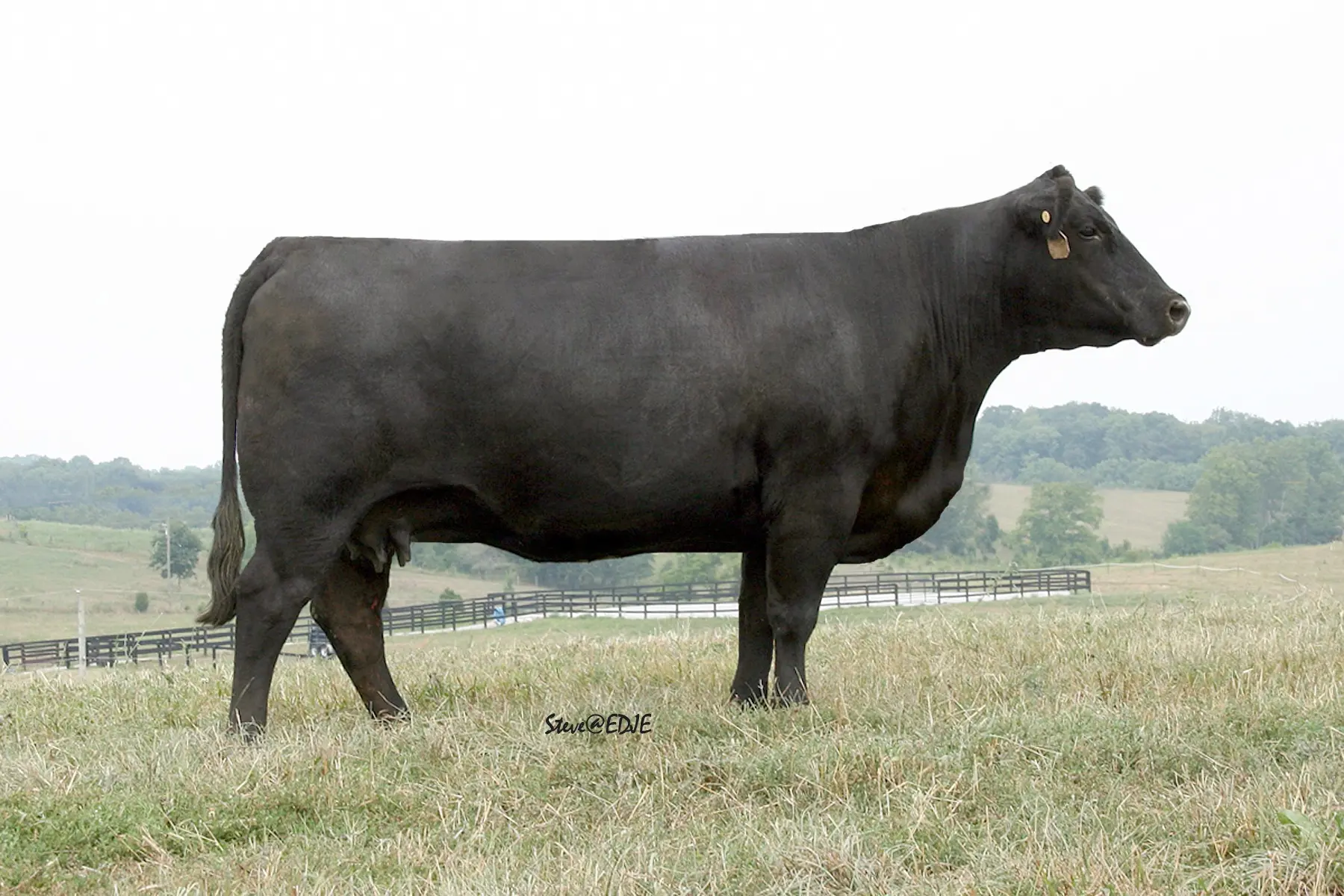
You cannot have a profitable cow herd without profitable cows. That is why we select cows that simply do their job.
A cow must breed early, calve unassisted, milk well enough to raise a big calf, maintain good body condition on fescue through a hot Kentucky summer, and breed back on time.
We study pedigrees and look at EPDs. But if a cow cannot live up to our standards in the real world, the numbers and names on her registration paper do not mean much.
As we continued selecting cattle to perform the same job under the same conditions, they naturally began to look alike. They became moderate framed, big middled, and stout made. They milk enough to raise a heavy calf, but not so much that they stay thin and fail to breed back.
We also learned that certain cow families consistently rose to the top, while entire families eventually fell by the wayside. The difference became even clearer when we stopped making excuses.
The turning point
Progress Began When We Stopped Saying “Yeah, But…”
A cow would come up open, and we would say, “Yeah, but she won a show seven years ago.”
A cow would develop a bad udder, and we would say, “Yeah, but she is sired by a national champion.”
A cow would wean a small calf, and we would say, “Yeah, but she has really good EPDs.”
The “yeah, buts” are easy to fall into—especially when the cow is a favorite, has an impressive pedigree, or carries a story we do not want to let go. But none of those things make an unprofitable cow profitable.
Doing the hard thing sometimes means selling a cow you love. When the farm payment is due, the banker does not want to hear, “I know I cannot pay you—yeah, but…”
There is not much you can put at the end of that sentence that changes the outcome.
Real progress started when we stopped selecting cattle based on the reasons we wanted to keep them and started holding every cow accountable to the job she was supposed to do.
The bottom line